On 29 September 2026, the UK Debt Management Office (DMO) borrowed £5.1bn on behalf of the government by issuing 4.875% Treasury Gilt 2036 with a face value of £5.3bn and a yield of 5.383%. The cost of these 10-year fixed-interest gilt-edged securities is the highest since 1998, highlighting just how expensive it has become for the government to borrow, especially for longer periods.
Issuing these bonds a couple of days later, on Thursday 1 October, could have seen an even higher cost with a yield of 5.5%, while issuing a 30-year gilt that morning would have cost more than 6.0%. This is despite the recent announcement by the Bank of England that it is scaling back its quantitative tightening programme of selling gilts purchased following the financial crisis and during the pandemic.
Yields in the UK and elsewhere are not only responding to the latest energy crisis and what that may mean for economic growth but also to competition in the debt markets from the AI construction boom.
Higher yields = borrowing shorter
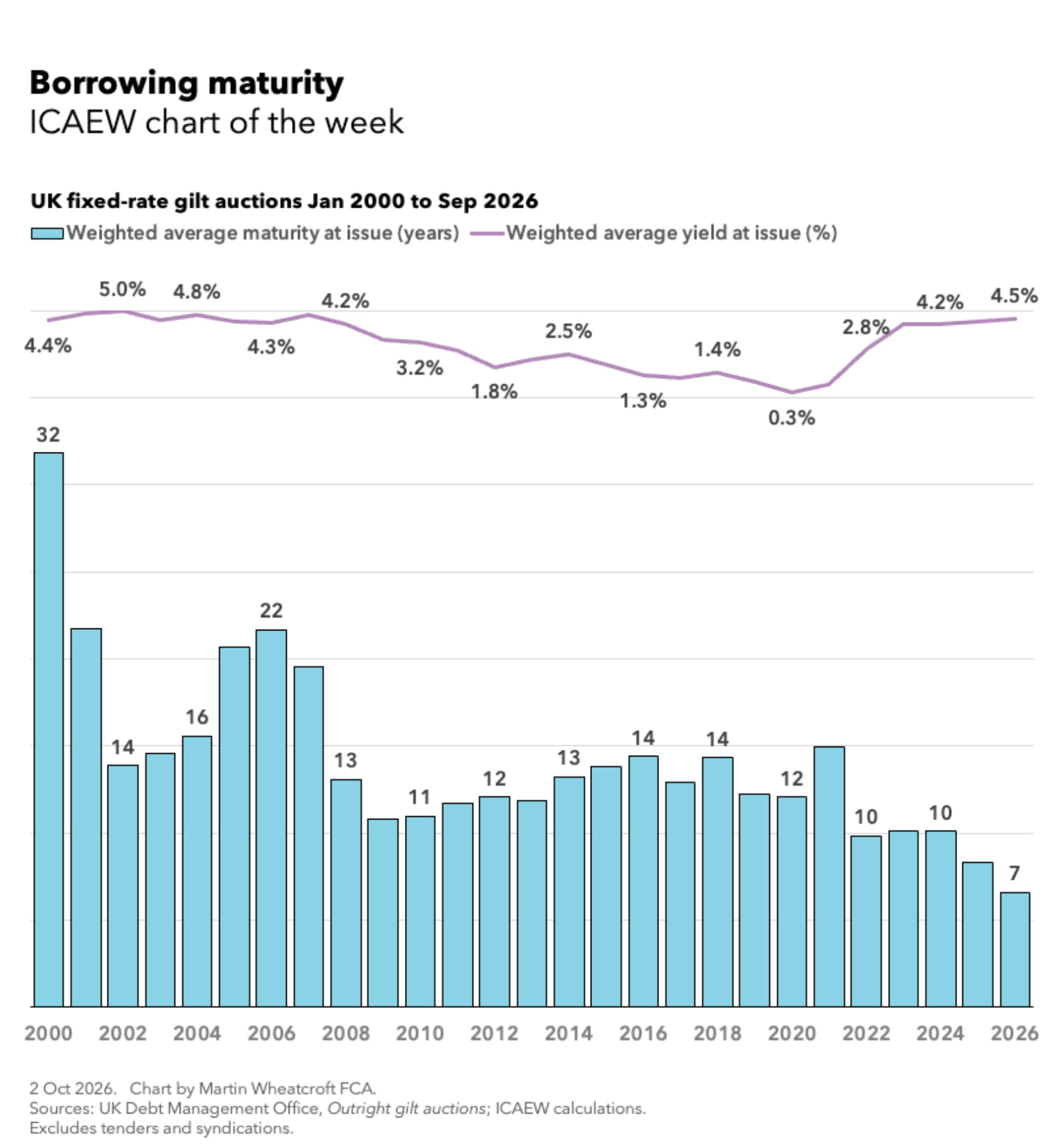
Our chart this week shows how the weighted average maturity at issue for fixed-interest gilts auctioned by the DMO fell from an average of around 20 years before the global financial crisis to an average of around 13 years up to 2021 and has been less than 10 years on average since 2022. Average maturities at issue were just under seven years in the first three quarters of 2026.
This means that the DMO is issuing proportionately more short-dated gilts with maturities of less than seven years than previously, fewer medium-dated gilts between seven and 15 years, and far fewer long-dated gilts over 15 years.
Our chart also shows how the weighted average yield at issue has fluctuated since 2000, averaging 4.6% before the global financial crisis, falling from 4.2% in 2008 to 0.3% in 2020, and then rising to 2.8% in 2022 and 4.5% in 2026.
Our chart doesn’t include index-linked gilts, which were issued at auction for an average maturity of 21 years between 2000 and 2021 (both before and after the financial crisis). The DMO has also started to reduce the average period over which it borrows using inflation-linked debt, with weighted average maturities at issue falling to 16 years in 2022 and further in subsequent years, reaching 11 years in the first nine months of 2026.
Real yields (adjusted for inflation) on the issue of index-linked gilts averaged around +1.8% before the financial crisis, dropping to an average of -0.8% between 2009 and 2022. They rose to +0.8% in 2023 and 2024 and around +1.5% in 2025 and 2026 to date.
Borrowing shorter = more refinancing
The DMO has historically aimed to issue debt for longer periods than its counterparts in other countries. This benefits the UK public finances by locking in (hopefully low) interest rates for longer and by reducing the amount of debt coming due for repayment each year that will have to be refinanced.
The shift to issuing debt for shorter periods deliberately increases the government’s exposure to changes in interest rates, with the hope being that interest rates will be lower when it comes time to refinance the gilts being issued today. Unfortunately, the risk is that yields could increase still further and what seems like a high cost today could look like a bargain tomorrow.
More refinancing = greater dependence on debt markets
More refinancing increases the amount of debt that the DMO needs to issue each year and hence the government’s dependence on the ‘kindness of strangers’ to plug the gap between the amount it raises in taxation and how much it spends and invests each year.
The challenge for finance ministers around the world, including the UK, is that a higher cost of borrowing puts further pressure on their public finances, making the fiscal choices they need to make even harder than they were already going to be.
ICAEW on the budget

Latest charts
Stay up to date
You can receive regular email updates from ICAEW insights, including weekly or monthly enewsletters. Subscribe to whichever works for you.
Sign upFurther resources
ICAEW Community

Public Sector Community
The go-to place for guidance on issues affecting finance professionals working in and with the public sector. With a range of dynamic services, ICAEW provides valuable tools, resources and support tailored to the public sector.
Resources

Economy explainers
ICAEW experts offer simple guides to help understand the technical, economic jargon that is discussed when talking about public finances and the economy.
Find out moreICAEW support

Training and events
Browse upcoming and on-demand ICAEW events and webinars offering support on technical areas, such as assurance, reporting and tax, as well as personal development.
Events and webinars A-Z of courses